How to Find Your Face Shape: A Step-by-Step Guide
Use a clear photo, four repeatable measurements, and a practical comparison instead of guessing from one selfie.

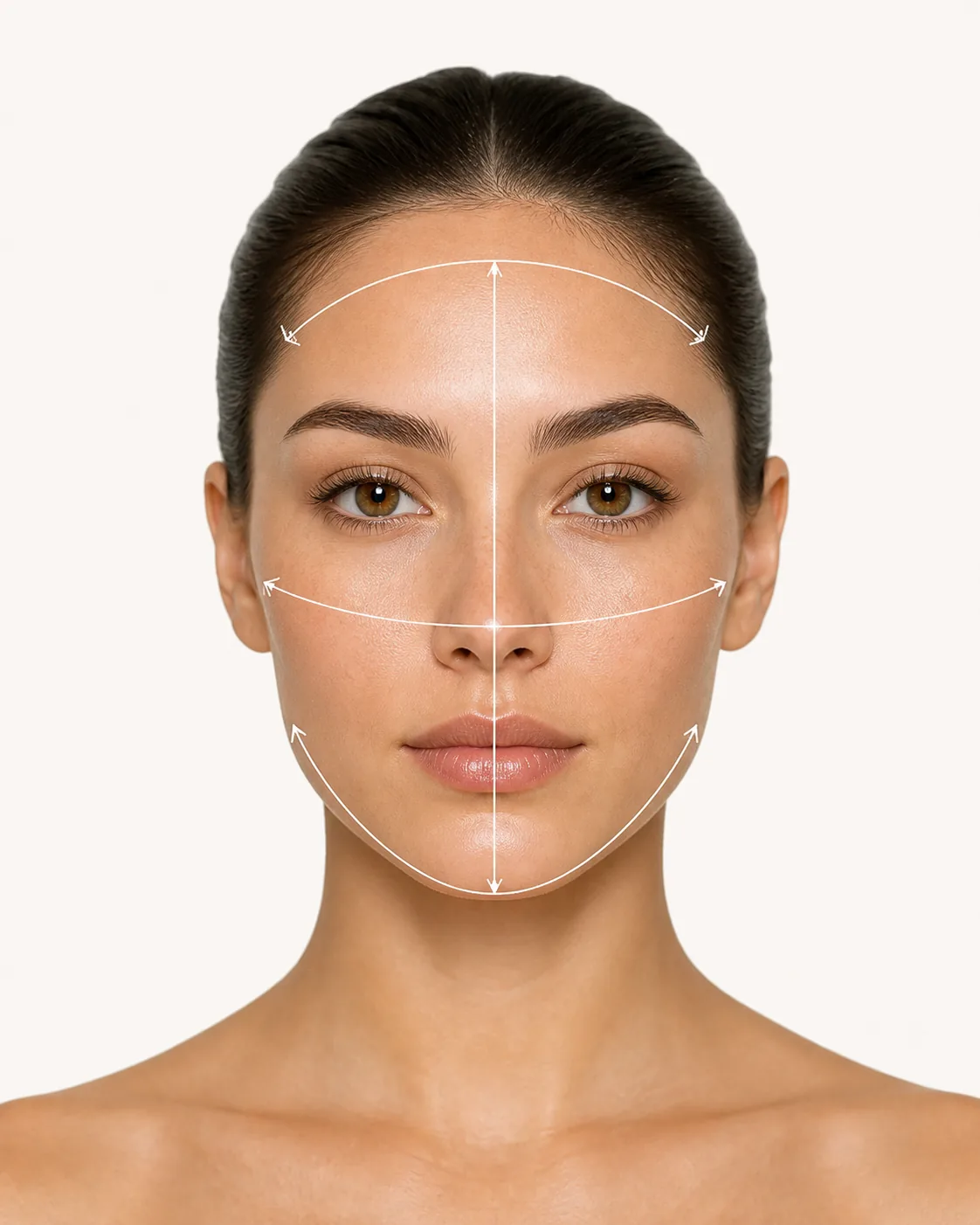
If you search for how to find your face shape, you will often see either a quick quiz or a list of labels. Those can be useful starting points, but they do not explain why a face looks oval rather than oblong, or round rather than square. This guide gives you a repeatable manual method first, then shows how a clear photo and an online calculator can confirm a close result. The goal is a useful styling direction, not a permanent label or a judgment about appearance.
The Reliable Way to Find Your Face Shape
Do not decide from one landmark. Read the face as a relationship between length, width, and the place where the outline carries the most visual weight.
- Compare length with width: A face that is clearly longer than its widest point often leans oval or oblong. When length and width are close, round or square may be a better starting comparison.
- Find the widest area: Look at the forehead, cheekbones, and jawline separately. Cheekbones that dominate can point toward diamond; a wider jaw can point toward triangle or square.
- Check the outline and chin: Soft curves, visible angles, a tapered chin, and a steady side outline help separate nearby categories. No single feature should decide the result alone.
- Use the result for a decision: Once you have a likely shape, choose what you want to balance: more height, more side width, softer angles, clearer structure, or a different glasses frame.
Prepare Your Mirror, Photo, and Measurements
Small setup changes can move the apparent outline, especially when hair, a close camera, or uneven light hides the jaw. Prepare the same way before comparing results.
- Move hair away from the outline: Pull hair back from the forehead and cheeks. A fringe or wide side volume is a styling choice, not part of the face measurement.
- Use one unit: Centimeters and inches both work. The important rule is to use the same unit and the same measuring method for every point.
- Keep your head level: Face the mirror or camera straight on with a natural expression. Tilting the chin changes the apparent length and jaw width.
- Repeat close measurements: If two numbers are close, measure twice and use the average. Consistency is more useful than pretending a soft outline is precise to the millimeter.
Measure Four Useful Points
A soft tape measure is easier than a rigid ruler because it follows the face without pressing into the skin. Write the values down before comparing categories.
- Face length: Measure from the center of the hairline to the tip of the chin. If the hairline is difficult to see, record an approximate starting point and treat the result as a range.
- Forehead width: Measure across the broadest visible part of the forehead, usually above the eyebrows and below the hairline. Keep the tape across the front rather than wrapping it around the head.
- Cheekbone width: Measure between the most prominent points of the cheekbones. This is often the widest point for diamond faces, but it must be compared with the jaw and forehead.
- Jawline width: Measure from one jaw angle to the other, or from the chin to one jaw angle and double it. Use only one method throughout your comparison because the two methods are not interchangeable.

Compare the Seven Common Face Shapes
Use this table as a pattern check, not a ranking. Many people sit between two shapes, and a mixed result such as oval-oblong or round-square is completely normal.
| Face shape | What to compare | Useful next direction |
|---|---|---|
| OvalBalanced and gently tapered | Face length is greater than width; forehead and jaw taper softly; cheekbones may be a little wider. | Most styling directions can work. Adapt the choice to hair texture, maintenance, and the feature you want to emphasize. |
| RoundSoft outline and similar width | Length and width are relatively close; cheeks look fuller; jaw angles are less pronounced. | Consider controlled height or clearer angles without adding unnecessary width at cheek level. |
| SquareStructured outline and strong jaw | Forehead, cheekbones, and jaw are fairly close in width; the jaw angle is visible. | Texture, movement, or rounded frame details can soften the outline when that is the goal. |
| OblongClearly longer than wide | Face length is dominant and the side outline may look relatively straight. | Side width, a lower fringe, or moderate crown height can reduce excessive vertical emphasis. |
| HeartWider upper face and tapered chin | Forehead or upper face is wider while the chin narrows; a widow's peak may appear but is not required. | Look for ways to balance the lower face without making the upper face look heavier. |
| DiamondCheekbones are widest | Cheekbones stand out while forehead and jaw are narrower; the chin may look pointed. | Gentle balance near the forehead or jaw can reduce emphasis on the widest point. |
| TriangleJaw is wider than the upper face | The jaw carries more width than the forehead, creating a lower-heavy outline. | A little openness or lift near the temples can balance a stronger lower face. |
Use a Photo Without Letting the Camera Mislead You
A photo can confirm the broad outline, but a close selfie or a dramatic angle can change the proportions. Take a neutral reference photo before comparing it with your measurements.
- Create distance: Place the phone farther away or use a timer. Wide-angle distortion is stronger when the camera is very close to the face.
- Keep the camera at eye level: The lens should face you rather than point up or down. Keep your head centered and do not push the chin forward.
- Choose even light: Use soft light that shows the forehead, cheekbones, jawline, and chin without a deep shadow on one side.
- Compare more than one image: If two clear front-facing photos show the same outline, that repeated pattern is more useful than a single result from a difficult angle.

What to Do When Two Face Shapes Look Close
Borderline results are common because face-shape categories are practical style groups, not exact biological boxes. Use the disagreement to identify which measurement needs a second look.
Oval versus oblong
Compare the length-to-width relationship and the side outline. A clearly dominant length and relatively straight sides lean oblong; a shorter length with gentle taper often leans oval.
Round versus square
Check whether the jaw has visible angles and whether forehead, cheekbones, and jaw are similar in width. A soft outline can still be slightly square, while a broad jaw does not automatically make a face square.
Heart versus diamond
Find the widest point. If the upper face is wider and the chin tapers, heart may be closer. If cheekbones dominate while forehead and jaw narrow, diamond may be the better comparison.
Use two methods
Retake a straight-on photo, repeat the four measurements, and compare both likely categories. Then choose the styling advice that solves the proportion you actually want to change.
A Ten-Minute Workflow for Finding Your Face Shape
Use this short process before choosing a haircut, glasses, beard outline, or a face-shape tool result.
- Take a neutral photo: Use even light, eye-level framing, a natural expression, and enough camera distance to reduce distortion.
- Clear the outline: Move hair away from the forehead and cheeks, and note whether facial hair is changing the visible jawline.
- Write down four measurements: Record face length, forehead width, cheekbone width, and jawline width in one unit.
- Find the widest point: Decide whether the forehead, cheekbones, or jaw carries the most width, then compare that with overall length.
- Choose a balance goal: Pick one practical goal such as adding side width, reducing vertical emphasis, softening angles, or adding structure.
- Confirm before changing style: Use the chart, calculator, or detector as a second opinion, then explain the balance goal to a stylist or optician.
Choose the Right Next Tool
Finding your face shape is useful when it leads to a concrete next step. Choose the page that matches the decision you want to make now.
Want a transparent measurement check?
Use the face shape calculator to enter forehead, cheekbone, jawline, and face-length values. It is useful when you want to see why a result leans toward one category.
Prefer a photo estimate?
Use the free face shape detector with a clear front-facing photo. Compare repeated results instead of treating one difficult image as final.
Choosing a hairstyle?
Move from the general shape to the hairstyle detector and consider hair texture, hairline, maintenance time, and the balance goal you chose.
Choosing glasses?
Use the glasses detector for frame direction, then prioritize bridge comfort, frame width, lens height, and your actual prescription fit.
How to Find Your Face Shape FAQ
Last updated: August 7, 2026